History of Nintendo

Hiroshi Yamauchi, who ran Nintendo for more than 50 years, passed away this morning. He played a great role in bringing the game consul to the American marketing and in the creation of Super Mario, Donkey Kong and Zelda. To take a look back at his life and his role in the company, here is an overview of the history of Nintendo (Part I), first published in Uncle John’s Ahh-Inspiring Bathroom Reader.
History of NintendoNO SALE

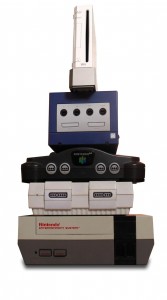
Back in 1981, Atari was the world leader in video games. In 1983 Nintendo offered to sell Atari the licenses to their Famicom game system, but they couldn’t come to an agreement, so Nintendo decided to go it alone.

They renamed the American version the Advanced Video System (AVS) and in January 1985, introduced it at the Consumer Electronics Show in Las Vegas, one of the largest such trade shows in the world.

They didn’t get a single order.

Nintendo’s problem wasn’t so much that the AVS was a bad system, but more that the American home video game industry was struggling. After several years of impressive growth, in 1983 sales of video game consoles and cartridges suddenly collapsed without warning. Video game manufacturers, caught completely off guard, lost hundreds of millions of dollars as inventory piled up in warehouses, never to find a buyer. Atari’s loss of $536 million prompted Warner Communications to sell the company in 1984.

Mattel sold off its version, Intellivision, the same year and shut down their entire video game division. Many other companies went out of business.

Canadian Superheroes

Not all superheroes fight for the “American Way.” Here is the history of some Canadian superheroes from our newest title, Uncle John’s Bathroom Reader Weird Canada.

Canadian SuperheroesJOHNNY CANUCK

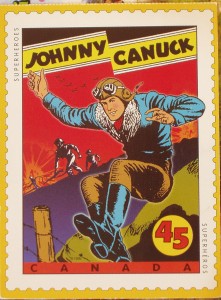
The original Johnny Canuck appeared in newspaper editorial cartoons in the 1860s. A working-class, tall-tale hero in the mold of Paul Bunyan, he sometimes appeared as a lumberjack, at other times as a farmer or a rancher. In 1942, in answer to the war and to the comics ban, the character received a reboot and was resurrected as a Nazi-fighting aviator and secret agent by 16-year-old Leo Bulche, who got the job after a chance encounter with the owner of Dime Comics. Later still, the lumberjack version of Johnny Canuck was adopted as the logo for the Vancouver Canucks, and he occasionally makes appearances on their uniforms on “retro nights.”

CAPTAIN CANUCK

Over the years, Captain Canuck has been the secret identity of three different Canadian secret agents: Tom Evans, Darren Oak, and David Semple. He wears a red-and-white costume based on the Canadian Flag, with a red Maple leaf on his forehead.

WOLVERINE

Wolverine was born in Alberta in the 1880s to the wife of a wealthy farmer and a groundskeeper named Logan, with whom she had an affair. Wolverine is a mutant who has retractable claws and regenerative powers that keep him from aging. In the late-20th century, Wolverine was a part of Canada’s Weapon X program, where his memories were wiped out and he had adamantium fused onto his bones, making him even stronger. A member of Marvel’s X-Men, Wolverine is regularly voted one of the most popular superheroes in the world.

Weird Hotels

Part of the fun of travel is enjoying the local flavor. So on your next trip, eat the local food, see the local sights…and stay at the local jail. Here are a few weird hotels we discovered. What is the weirdest hotel you have ever stayed in?

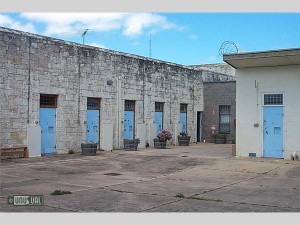
weird hotels the old jailHOTEL: The Old Jail
LOCATION: Mount Gambier, Australia
DESCRIPTION: The Old Jail offers the accommodations—and decidedly spooky atmosphere—of a huge, 19th-century rural prison. The hotel was once the South Australian State Prison, which operated from 1866 to 1995. Not much has changed when it was converted into a hotel. Showers are still communal and best are still cots, but the cell doors can now be opened from the inside. “Inmates” sleep four to a cell (either with strangers or family) or can pay double for a private, two-person suite.

It’s a Fake!

The moral of this story could be “Don’t believe everything you read,” because not only do writers make occasional mistakes, some writers intentionally insert fictitious facts into their works of non-fiction.

Fake FactsAuthors or publishers have a lot of reasons for inserting the occasional fake fact in an otherwise rigorously researched reference book—they may be laying a “copyright trap” to see if anybody uses their book without giving credit. Or sometimes they just do it because it’s fun to trick people.

FAKE SONG. Joel Whitburn compiles music chart history books based on Billboard’s many charts, which go back to the 1930s. A number of his books note a very obscure song called “The Song of Love” recorded by bandleader Ralph Marterie. Whitburn says the song debuted and peaked at #84 on the pop chart for the week of December 26, 1955. However, Marterie never recorded “The Song of Love.” Nor did Billboard put out a chart the week of December 26, 1955. Whitburn included it to track just how far and by whom his research goes. (Ralph Marterie, however, was a real bandleader and made several recordings in the 1950s.)

The Wonderful World of Disneyland

Disneyland facts: amazing things you probably never knew about the Happiest Place on Earth.

Disneyland Facts• The park has a large security force. It’s mostly undercover…but there are more Disney security officers than there are police officers in the adjacent city of Anaheim.

• Employee slang for being a costumed character: “duck duty.”

• In the Toy Story movies, the toys would all freeze and drop to the ground when their human owner Andy was approaching. If you yell “Andy’s coming!” when costumed Toy Story characters are out and about…they will freeze and drop to the ground.

Beep Me! (Beeper Codes)

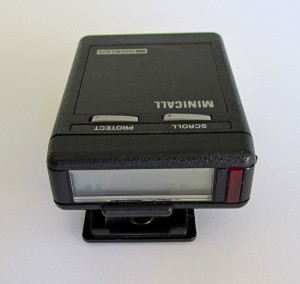
Before email, cell phones, and text messaging, people had to instantly communicate with beepers. And a secret language of beeper codes.

Beeper codesFrom the mid-‘90s to the early 2000s, before cell phones became ubiquitous, the best, cheapest way for parents to keep track of their teenagers, and for teenagers to keep track of each other, were beepers, or pagers. Here’s how it worked: From any phone, you’d dial a friend’s beeper number. They’d receive a simple text message on their pager’s display: your number, and any other numbers you wanted to include. For example: “911” would mean “call me right now – it’s an emergency.”

From that spawned a new language of beeper codes. Those little coded messages became both a shorthand, a way to actually communicate via the very limited capacity of a pager, and also a way to shut out uninformed, nosey parents. Here are some of those old beeper codes. (While some of them make perfect sense, others seem quite random. But who can understand these kids today…or yesterday?)

Toy Fads: The Saga of the Lost He-Man Action Figure

It’s the rarest action figure of all time…because it didn’t exist.

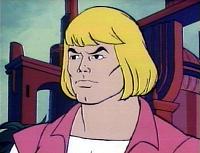
he-manHe-Man and the Masters of the Universe was the bestselling “action figure” line of the 1980s. From 1982 to 1988, when the toys were produced in conjunction with the Masters of the Universe cartoon series, Mattel sold $1.2 billion worth of “He-Man,” “Skeletor” and dozens of other MOTU action figures. But apparently there was room for more. In 1986, the Masters of the Universe Magazine held a “Create-a-Character” contest. The magazine’s editors would chose five semi-finalists and readers would vote on the winner. The grand prize: a $100,000 scholarship, a trip to Disneyland, and, perhaps best of all, Mattel would make the winning character into an action figure.

The contest winner was 12-year-old Nathan Bitner for his character, “Fearless Photog.” Photog had a camera for a head and used his camera-head to take “photos” of his enemies, which would drain their strength and transfer their image to his chest plate. Bitner got his scholarship and his Disney vacation, but unfortunately, Mattel never followed through with the rest of the bargain. Fearless Photog was never manufactured. (Interestingly, Bitner went on to design other sci-fi characters—in the 1990s, he worked at Bungie, the video game company that developed the five-million-selling Halo.)

Giant Rubber Duck News: Power to the People

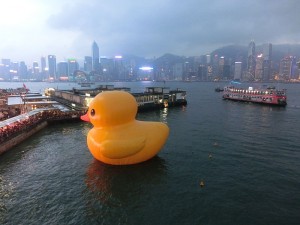
In May, we told you about a public art event very close to our hearts here at the BRI: Dutch artist Florentijn Hofman’s unveiling of a 54-foot-tall giant rubber duck in Hong Kong’s Victoria Harbor. It looks just like the rubber ducky seen on the covers of all of our books…only much, much bigger. On June 4, 2013, the duck made news in China—and around the world—again.

June 4th is the anniversary of the Tiananmen Square Massacre. In 1989, thousands of protestors occupied Beijing’s Tiananmen Square, protesting China’s Communist government. The government responded by sending in 300,000 troops to quell the protests. Six thousand protestors were killed. The tragedy spawned a lasting, powerful image: a single, Chinese man, standing in front of a row of tanks.

In China, publicly commemorating the massacre (officially known as “The June 4th Incident”) is forbidden, so many people protest online. But criticizing the government online is also illegal in China. So what do protesters do? This year they made pictures.

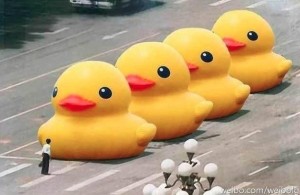
Giant Rubber Duck ChinaOne person recreated the famous photo (the original of which is illegal to distribute in China) entirely with Lego blocks. Another person doctored the photo and replaced the tanks with images of the Giant Floating Duck.

Once the Internet-regulating authorities figured out what was going on, the Giant Floating Duck-as-tank photo was banned. Nevertheless, the duck is now a symbol of quiet protest in China.

The real duck, fully inflated, is scheduled to arrive in Pittsburgh in September.

3 Real-Life Statues Commemorating Fictional Characters

Robocop. Detroit has had some hard times lately, but there’s one bright spot on the horizon: construction and placement are nearly completed for a statue of Robocop. The original 1987 film, Robocop, was about the half-man, half-robot, all-violent policeman saving a futuristic, crime-destroyed version of the city. The kooky project was dreamt up by a group called Imagination Station Detroit. In 2011, they raised $57,000 via Kickstarter to make the 10 foot-tall statue honoring a favorite son a reality.

Optimus Prime. A 32-foot tall, 21-ton statue of the leader of the Transformers stands proudly in a square in Shenyang City, China. And, like how Transformers are vehicles that can rapidly transform into giant robots, “transforming” parts from 21 abandoned cars and trucks created this Optimus Prime statue. It’s the biggest Optimus Prime model on Earth…which means it’s not the only one. There’s another Optimus Prime statue in Beijing.

Rocky and Bullwinkle. And now here’s something we hope you’ll really like: This 15-foot tall fiberglass statue of the cartoon “moose and squirrel” was constructed in 1961 to promote the premiere of The Bullwinkle Show on NBC. Actress Jayne Mansfield presided over the unveiling, which took place along the Sunset Strip in LA and drew 5,000 spectators. The statue can be found at 8218 Sunset Boulevard in front of Hollywood Hounds, a grooming salon for pets.


Pop Culture Pizza Pies

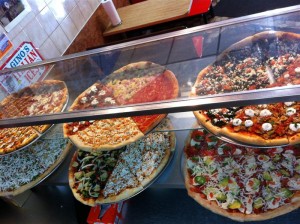
pop culture pizzaThere are approximately 50 billion pizza joints in New York City, but Vinnie’s Pizzeria in Brooklyn is arguably the coolest. For the past few years, co-owner Sean Berthiaume has created dozens of special pizzas with punny names, many “ins-pie-red” by popular TV shows. We call these pop culture pizza pies. Here are a few of our current favorites:

Mad Men

• The “Mad Mein” is topped with chicken chow mein, stir-fried noodles, teriyaki chicken, onions, broccoli, and cheddar cheese

• The “Don Caper” (a play on “Don Draper”) includes capers, tomato, garlic, “soy (Jon) Hamm,” soy cheddar, and mozzarella.

Game of Thrones

• The “Pita Linkage” (named for co-star Peter Dinklage) is an open-faced pita pizza with sliced sausage links, red onions, roasted red peppers, and feta cheese.

• The “Khal-Cheesy” (named for “The Khalesi,” portrayed by Emilia Clarke) has cheddar, provolone, mozzarella, and parmesan cheeses with sliced “pepper-thron-i.”

South Park

• The “South Pork” is topped with salami, ham, bacon, onions, and peppers.

Iron Man vs. The Mandarin vs. Racism

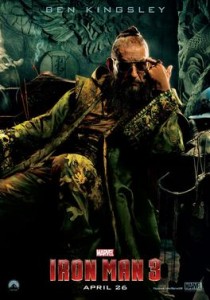
Iron Man 3Surefire blockbuster Iron Man 3 gets the summer movie season going when it’s released tonight. The villain who will try to take down Tony Stark this time: The Mandarin, an original character from comic books of the 1960s. Fortunately, the blatantly racist, stereotypically Asian elements of the character have been toned down for the movies (and he’s played by Sir Ben Kingsley).

Here are couple other questionable—and offensive—comic book characters.

Bad Ads You Might Have Missed

Last month, Ford Motors landed in hot water after a series of sexist advertisements it ran in India.

The three ads feature illustrations of Paris Hilton, former Italian prime minister Silvio Berlusconi, and German racecar driver Michael Schumacher each sitting in the front seat of a Ford Figo. In each ad, the celebrity had their “enemies” tied up in the trunk (to demonstrate how big it was). Hilton had paparrazi bound and gaggedl Schumaker had rival drivers. Berlusconi had a bunch of scantily clad models in his trunk.

Of course, this isn’t the first time an ad campaign has courted controversy. Last year, the makers of Pop Chips thought it would be hilarious to dress actor Ashton Kutcher up as “Raj,” a sleazy, thick-accented Bollywood producer and stick him in a commercial. Following an outcry on the Internet, the company yanked the ad. But here it is!

Monopoly “Iron” Token Out, “Cat” In

.
Wow – hadn’t even heard they were doing this! We would have started a “toilet” token movement!

The Monopoly iron is going off to that giant linen closet in the sky.

The token, a staple of the Hasbro board game since the 1930s, is being retired after only garnering 8% of fan votes in a “Save Your Token” campaign. The Scottie dog was the clear choice for fans and game players from 185 countries, getting 29% of the vote.

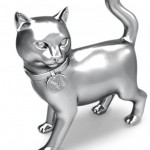
While the iron leaves the game, a new cat will take its place passing “GO!” and collecting $200 going forward. The feline piece conquered its own competition in a separate vote on theMonopoly Facebook page, winning over four other proposed tokens — a toy robot, guitar, helicopter and diamond ring — with 31%.

Monopoly extras: